
Latest dividend announcement
The Bank of New York Mellon Corporation declared a quarterly common dividend of $0.53 per share for the second quarter of 2026. The dividend remains unchanged compared with the previous quarter, confirming a stable distribution policy. The forward annualized dividend amounts to approximately $2.12 per share, implying a forward yield of about 1.6% at current price levels.
Details of the dividend distribution
BNY will pay the dividend on May 8, 2026, to shareholders of record as of April 27, 2026. The ex-dividend date is also set for April 27. The company continues to combine cash dividends with share repurchases as part of its capital return framework. In the latest quarter, BNY returned roughly $1.4 billion to shareholders, including $0.38 billion in dividends and substantial buybacks. This dual approach supports total shareholder yield beyond the cash dividend alone.
Relevant valuation metrics
BNY currently trades at a forward P/E ratio of 14.3, below the broader market multiple, which suggests moderate valuation levels. The price-to-book ratio of 2.34 reflects a premium to tangible equity, supported by strong profitability. The bank generated a return on equity of approximately 16% and a return on tangible common equity near 29%, indicating efficient capital deployment.
From a dividend perspective, the payout ratio stands near 27%, which remains conservative for a custody bank with stable fee income. Free cash flow coverage appears adequate, with a P/FCF ratio of 17.8, suggesting sufficient capacity to fund dividends and repurchases. Earnings growth expectations remain solid, with consensus projecting double-digit EPS growth over the next year and a long-term growth rate above 11%.
Dividend history and sustainability
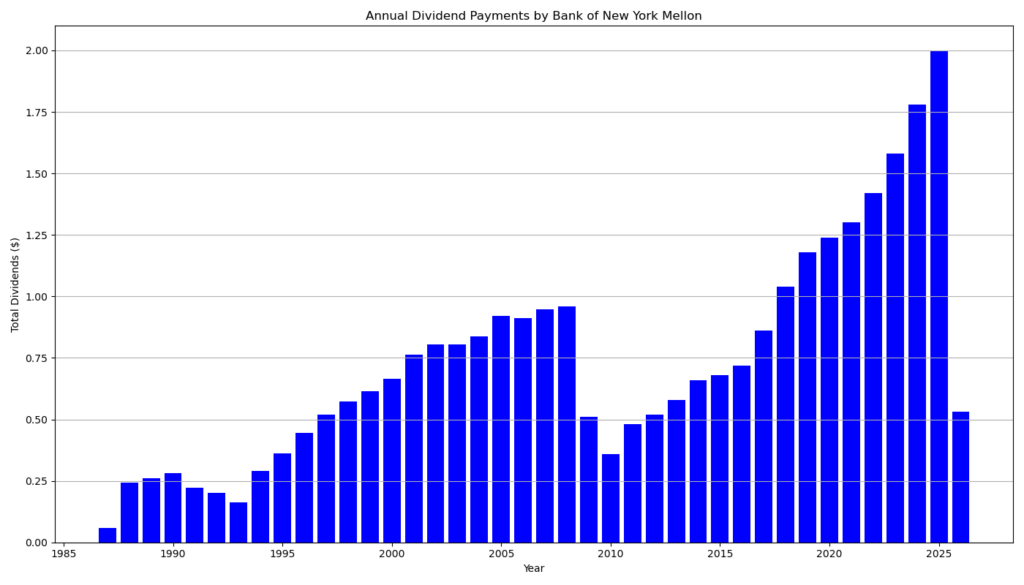
BNY has established a consistent dividend track record. The company has paid dividends for 26 consecutive years and increased its payout for 15 consecutive years. The most recent dividend increase occurred in mid-2025, when the quarterly payout rose from $0.47 to $0.53, representing a growth rate of approximately 12.8%.
Since then, the dividend has remained stable at $0.53 for four consecutive quarters. This pause does not indicate deterioration. Instead, it reflects a normalization phase following a strong increase. Over the past five years, dividend growth has averaged around 10% annually, which aligns with earnings expansion. The low payout ratio and strong capital generation support continued dividend sustainability.
Outlook for long-term investors
BNY operates with a capital-light business model that generates recurring fee income from custody, asset servicing, and wealth management activities. This structure provides resilience across economic cycles and supports stable cash flows.
Revenue growth of 13% year-over-year and EPS growth of over 40% in the latest quarter highlight strong operating momentum. Net interest income benefits from higher rates, while fee income grows with market activity and client inflows.
For dividend investors, the key variables remain capital ratios and payout discipline. BNY reported a CET1 ratio of 11.0%, which remains solid but slightly lower sequentially. The company maintains flexibility to increase dividends further once capital buffers stabilize.
The current yield appears modest, but the combination of dividend growth, share repurchases, and earnings expansion enhances total return potential. Long-term investors should view BNY as a compounder rather than a high-yield income stock.
A brief company profile
The Bank of New York Mellon Corporation is a global financial services institution headquartered in New York. The firm specializes in asset servicing, custody, clearing, and investment management. It oversees approximately $59 trillion in assets under custody and administration and manages over $2 trillion in assets under management. BNY serves institutional clients, governments, and financial intermediaries worldwide and plays a central role in global capital markets infrastructure.
last quarterly report*
Here is a concise summary of the BNY Q1 2026 earnings report:
Core financial performance
- Revenue reached $5.4 billion, up 13% YoY, driven by higher fee income and net interest income.
- Net income attributable to shareholders was $1.56 billion, up 36% YoY.
- Diluted EPS increased to $2.24, a 42% YoY gain.
Profitability
- Pre-tax margin improved to 37% (vs. 32% last year).
- Return on equity (ROE): 16.1%
- Return on tangible common equity (ROTCE): 29.3%
→ Indicates strong operational efficiency and capital utilization.
Revenue drivers
- Fee revenue (+11%): Higher client activity, market values, and FX revenue.
- Net interest income (+18%): Benefit from higher yields and balance sheet growth.
Balance sheet and scale
- Assets under custody/administration: $59.4 trillion (+12%)
- Assets under management: $2.1 trillion (+6%)
→ Reflects continued client inflows and favorable market conditions.
Capital return
- Total capital returned: $1.4 billion
- Dividends: $376 million
- Share buybacks: $983 million
- Payout ratio: 87%
→ High shareholder distribution, though heavily reliant on buybacks.
Capital position
- CET1 ratio: 11.0% (slightly down sequentially)
- Tier 1 leverage ratio: 6.0%
→ Still solid but trending modestly lower due to higher risk-weighted assets.
Key takeaway
BNY delivered strong earnings growth and margin expansion, supported by higher interest income and fee growth. Capital returns remain high, but the elevated payout ratio and slight capital ratio compression warrant monitoring for dividend sustainability.
*This is the latest quarterly report that the company has filed with the SEC.
Next Earnings Date: 7/14/2026 6:00 AM
Die Selektion dieser Aktie erfolgte zufällig aus einem breiten Spektrum an tagesaktuellen Börsenmitteilungen bezüglich angekündigter Dividendenzahlungen. Der vorliegende Beitrag zielt nicht auf eine qualitative Bewertung dieser dividendenstarken Aktie ab, sondern verfolgt einen rein deskriptiven Ansatz.
Was sind Dividend Champions, Contenders, Challengers?
Disclaimer: Dieser Bericht dient ausschließlich Informationszwecken und stellt keine Anlageberatung oder Empfehlung zum Kauf oder Verkauf von Wertpapieren dar. Für die Richtigkeit der Daten wird keine Gewähr übernommen.